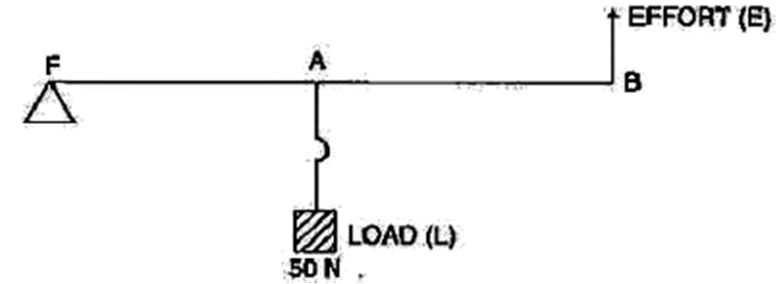
38 the diagram shows a lever. the mechanical advantage of the lever is
Levers and Mechanical Advantage - 8th Grade Integrated Science Mechanical Advantage for Levers To calculate the mechanical advantage of levers, you can use one of 2 formulas. 1. Mechanical Advantage = Effort Distance / Resistance Distance (MA = ED/RD) This formula is used when you are given meters. The effort distance is the distance from the effort to the fulcrum. In the picture to the left that's dE. Mechanical advantages of levers - Movement analysis - OCR - BBC Mechanical advantages of levers Levers are used to multiply force, In other words, using a lever gives you greater force or power than the effort you put in. In a lever, if the distance from the...
Solved Class II levers such as the wheelbarrow are useful | Chegg.com Transcribed image text: Class II levers such as the wheelbarrow are useful because they provide mechanical advantage, by amplifying the input force to provide a greater output force. In other words, we can lift a load without having to lift the full weight of the load. Prove this mathematically. You will need to use the rotational equilibrium condition and trigonometry.
.gif)
The diagram shows a lever. the mechanical advantage of the lever is
The diagram shows a lever in use. - Toppr Ask The diagram shows a lever in use. Without changing the dimensions of the lever, if the load is shifted towards the fulcrum what happens to the mechanical advantage of the lever? Medium Solution Verified by Toppr The diagram below shows a lever in use. The diagram below shows a lever in use. (a) To which class of lever does it belong? (b) If AB =1 m, AF= 0.4 m, find its mechanical advantage. (c) Calculate the value of E. Machines ICSE 2 Likes Answer (a) The diagram represents a Class I lever. (b) Given, AB = 1m AF = Load arm =0.4 m BF = Effort arm = 0.6 m The diagram shows a lever. The mechanical advantage of the lever is ... Explanation: A lever is usually defined as a long and hard rod, with a fulcrum that is needed to place near the object in order to lift it. This is has a great mechanical advantage as l ess amount of force is needed to apply in order to lift a heavier object. The longer beam helps in lifting the heavier objects. It is very widely used.
The diagram shows a lever. the mechanical advantage of the lever is. Mechanical Advantage Formula, Equation & Example | What is the ... The mechanical advantage for a simple machine such as a lever is: Mechanical Advantage= Load / Effort We can assume that when the mechanical advantage is >1, the output force is more than the input... Law of the Lever: Definition, Formula & Examples - Study.com The law of the lever is also known as the law of moments and equates clockwise torques and counterclockwise torques. The equation here shows the law of levers: Equation 1. F1 is force 1. d1 is the ... Solved Use the lever diagram. The mechanical advantage is - Chegg Transcribed image text: Use the lever diagram. The mechanical advantage is for LA = 6 in 1 - 2 in R 10lbs 12lbs Isometric contraction Fulcrum Force/Power None of the answers shown Speed/Distance Question 4 The biceps muscle will function to lift a 10 lb. dumbbell when: All of the answers shown The muscle contracts eccentrically The effort is greater than the resistance The elbow functions as a ... The diagram below shows a lever in use - Sarthaks The diagram below shows a lever in use : (i) To which class of levers does it belong? (ii) Without changing the dimensions of the lever, if the load is shifted towards the fulcrum what happens to the mechanical advantage of the lever? icse class-10
The diagram shows a lever. What is the mechanical advantage of the ... Weegy: A comma should follow a dependent clause when the dependent clause comes first in a sentence. (More) The mechanical advantage of a wheel and axle is the radius of the wheel divided by the radius of the axle. On wheel and axle A, the wheel and axle are very close in size. On wheel and axle B, the radius of the wheel is much greater than ... EXAM 1 Lecture 2 Levers Mechanical Advantage - Quizlet yes. Mechanical advantage for 1st class lever. variable. but usually the mechanical advantage of the muscle will be shorter than the mechanical advantage of the external force. Mechanical advantage for 2nd class lever. mechanical advantage will ALWAYS be greater than 1. Mechanical advantage for a 3rd class lever. Levers Flashcards | Quizlet Class III Levers. the fulcrum and the resistance force must be at opposite ends with the applied force somewhere in between - mechanical disadvantage - speed is gained although power is lost - ex. a bicep curl. Class I Lever at a mechanical disadvantage. if the force arm is shorter than the resistance arm. Class I lever at a mechanical advantage. Mechanical advantage of levers - Movement analysis in sport - AQA ... Some levers operate with mechanical advantage. This means that the lever can overcome a large load with relatively little effort. Mechanical advantage is very useful for joints which are weight...
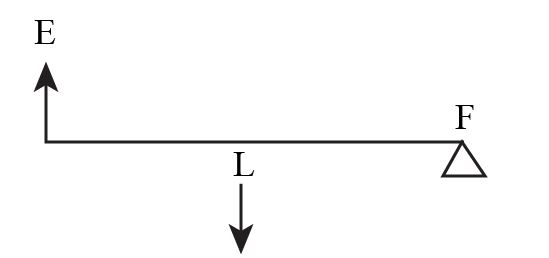
The diagram shows a lever. The mechanical advantage of the lever is ... The mechanical advantage of the lever is (_____). 2 See answers Advertisement Advertisement susseiowo susseiowo Answer:If the diagram shows 3 m and 6 m the answer would be 2. Explanation: Advertisement Advertisement liapearson liapearson Answer: the awnser is 2 . Explanation: because its correct and its right on edge 2020. Mechanisms: The Lever, It's Everywhere | Hackaday MA stands for Mechanical Advantage and is a measure of how much the force is amplified. The formula shows that if length afrom the fulcrum to the effort is greater than length bfrom the fulcrum to... The diagram below shows a lever in use:(i) To which class of lever does ... asked Nov 30, 2018 in Physics by alam905 (91.1k points) The diagram below shows a lever in use: (i) To which class of lever does it belong? (ii) Without changing the dimensions of the lever, if the load is shifted towards the fulcrum what happens to the mechanical advantage of the lever? icse class-10 The Diagram Below Shows a Lever in Use: to Which Class of Levers Does ... The diagram below shows a lever in use: 1) To which class of levers does it belong? 2) Without changing the dimensions of the lever, if the load is shifted towards the fulcrum what happens to the mechanical advantage of the lever? Advertisement Remove all ads Solution 1) It belongs to the class-II lever. 2) If local is shifted towards the fulcrum.
Principles of Engineering at RMHS: More Simple Machines
Lever Systems, Examples of their use in Activity and the Mechanical ... The diagram shows a person kicking a football. Complete the table to show the joint action occurring at the knee from position A to position B and the agonist muscle group that causes this action ...

Machines ICSE Class-10 Concise Selina Physics Solutions - ICSEHELP
Levers - Creative Mechanisms What is a Lever? Levers are mechanical devices used to scale the amount of force and/or travel in a mechanism.Levers are a versatile mechanism that can be used in a wide range of applications from small to large. For example, levers can be used to gain a mechanical advantage, allowing a small input force to exert a much higher output force.
Wide Angle Geometry
Simple Machines: How Does a Lever Work? - Owlcation One of the main features of a lever that makes it useful is that it can have a mechanical advantage. This means that when a force is applied to one point on the lever (e.g. the end), another part of the lever can exert a larger force. So, for instance, a tool called a bolt cutter has long handles which give it a lot of mechanical advantage.

4. Actions, Levers, and Decisions - Analytical Skills for AI and Data ...
The diagram shows a first class lever. How far down will the effort ... Get an answer for 'The diagram shows a first class lever. How far down will the effort side have to move to lift the load 1 m?' and find homework help for other Science questions at eNotes.
Write a relation between the angle of incidence (i), angle of emergence ...
Simple Machines - Levers | Let's Talk Science A lever provides mechanical advantage. Mechanical advantage refers to how much a simple machine multiplies an applied force. The location of the effort, load, and fulcrum will determine the type of lever and the amount of mechanical advantage the machine has. The farther the effort is away from the fulcrum, the easier it is to move the load.
Cranks and Crank Shafts
Mechanical Advantage of a Lever with Formula - PhysicsTeacher.in Mechanical Advantage formula of a lever = Load lifted/Effort applied= L/E ……………… (equation 1) In the diagram below, you can see that the Effort (E) is trying to provide a CW (Clock Wise) rotation to the lever rod. On the contrary, the Load L (the weight to be lifted, say) is trying to give an ACW (Anti Clock Wise) rotation to the rod.
The diagram below shows a lever in use Without changing class 11 ...
The diagram below shows a lever in use. - Shaalaa.com The Diagram Below Shows a Lever in Use. (I) to Which Class of Lever Does It Belong? (Ii) If Fa = 40 Cm, Ab = 60 Cm, Then Find the Mechanical Advantage of the Lever. CISCE ICSE Class 10. Question Papers 359. Textbook Solutions 25661. MCQ Online Tests 6. Important Solutions 3377.
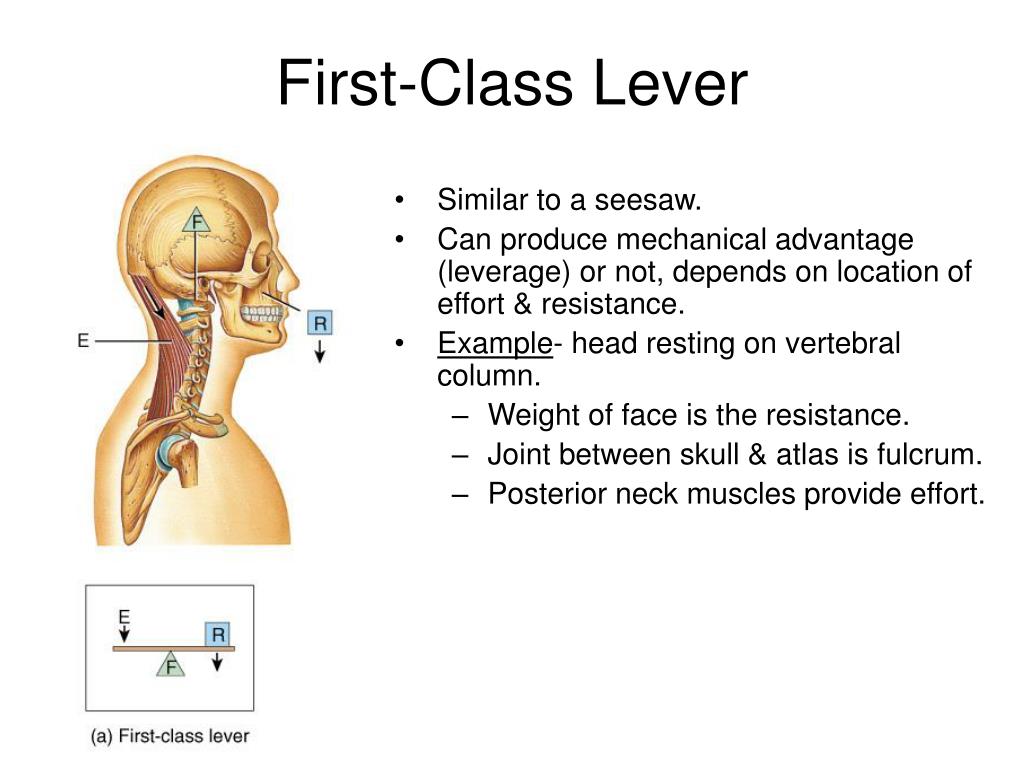
PPT - Lecture 6 Muscles PowerPoint Presentation, free download - ID:435441
The diagram shows a lever. The mechanical advantage of the lever is ... Explanation: A lever is usually defined as a long and hard rod, with a fulcrum that is needed to place near the object in order to lift it. This is has a great mechanical advantage as l ess amount of force is needed to apply in order to lift a heavier object. The longer beam helps in lifting the heavier objects. It is very widely used.
0 Response to "38 the diagram shows a lever. the mechanical advantage of the lever is"
Post a Comment